Hydrostatic Level Sensors: Measuring Liquid Level with Simple Physics
Title: How do you measure liquid level by trusting a fundamental law of physics? Discover the working principle of hydrostatic level sensors.
Introduction: Have you ever wondered how the fuel level in massive storage tanks or the water in deep wells is precisely monitored? One of the most common and robust methods is hydrostatic measurement. In this article, we will explore how these devices work and why they are so widely used across various industries.
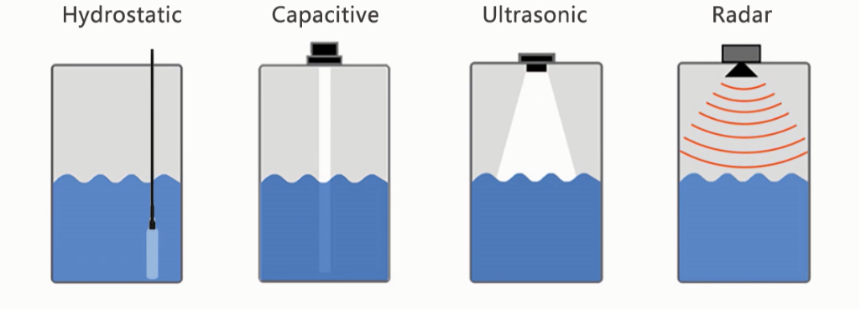
The Working Principle: An Unchanging Law of Physics
The heart of every hydrostatic level sensor is Pascal’s Law, specifically the relationship between the height of a liquid column and the hydrostatic pressure. It states that the pressure exerted by a fluid is directly proportional to its density, the height of the fluid column, and gravity.
In practical terms, this means the higher the liquid level in a tank, the greater the pressure at its bottom. A hydrostatic sensor, mounted at the bottom or on the side wall of a tank, measures precisely this pressure. Then, knowing the density of the liquid (which is a constant for a given medium), the sensor’s transmitter accurately converts the measured pressure value into units of length, providing a precise level reading.
https://www.apureinstrument.com/wp-content/uploads/2022/08/hydrostatic-level-transmitter-working-principle.jpg
Figure 1: The working principle – pressure at the tank bottom (P) is directly dependent on the height of the liquid column (h) and its density (ρ). Source: apureinstrument.com
Types of Hydrostatic Sensors
We can distinguish two main types of these devices:
- Submersible sensors (with a probe cable): This is the most common type. The sensor in a hermetic housing is lowered to the bottom of the tank (e.g., a well, lake, or open basin). It measures the pressure of the liquid column directly above it.
- Tank-mounted sensors (non-submersible): The device is mounted externally on the tank’s bottom or side wall. It measures pressure through a process connection.
https://www.anderson-negele.com/globalassets/product-images/level/hydrostatic-level-sensor-lh-20/lh-20-in-tank_web.jpg
*Figure 2: A submersible hydrostatic sensor with a probe cable. Source: anderson-negele.com*
Advantages and Applications
Why choose them?
- Simple construction: The lack of moving mechanical parts means less wear and higher reliability.
- High accuracy: Modern transmitters provide very precise measurements.
- Versatility: They are suitable for measuring the level of various liquids – from drinking water to aggressive chemicals (when constructed with appropriate housing and diaphragm materials).
- Resistance to external factors: They are not affected by turbidity, foam, steam, or liquid turbulence.
Where are they most commonly used?
- Level measurement in deep wells and water storage tanks.
- Monitoring fuel levels in underground and above-ground storage tanks.
- Drainage systems and stormwater management.
- Chemical and food processing industries.
Conclusion
Hydrostatic level sensors are a perfect example of how simple laws of physics find invaluable application in modern industry. Their reliability, accuracy, and lack of complicated mechanics make them a primary choice for engineers designing measurement systems for liquids. It’s a solution that simply works.